Your Cart is Empty

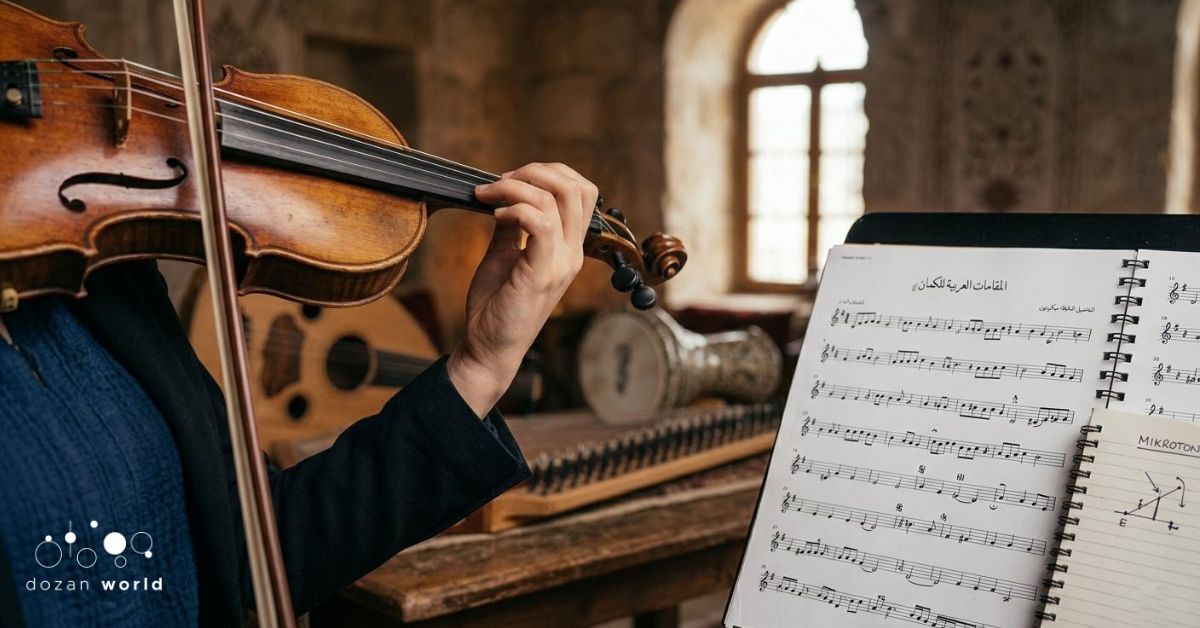
The violin is widely used in Arabic and Middle Eastern music today, from solo recitals to full orchestras. Arabic music is built around maqam, a system of melodic modes rather than fixed major and minor scales. A standard Western violin can perform maqam without any modification to the instrument itself. What changes is the player: intonation, finger placement, ornamentation, phrasing, and bowing all shift to suit the mode. Some maqamat use pitches that fall between the notes of the Western twelve-tone system, which is why listening plays such a large role in learning this repertoire. Originally, the Middle Eastern violin was tuned differently from the Western violin, but with time, it was adapted to the Western turning system. If you play violin and want to explore this tradition, Dozan World's Middle Eastern sheet music collection is a good place to start building a repertoire.
A maqam is a melodic and modal system, not just a scale. Each maqam has a set of pitches, but it also carries its own melodic pathways, characteristic phrases, and important resting notes that the melody tends to return to. Two maqamat can share similar pitches on paper and still sound completely different because of how the melody moves between them.
This is where maqam differs most from Western major and minor scales. In Western music, a scale mostly tells you which notes are available. In maqam, the sequence and emphasis of notes carries as much meaning as the notes themselves. You cannot reduce a maqam to "here are the seven notes" and expect the same musical result. Melodic development, the way a musician builds and releases tension across a phrase, is central to how a maqam is actually performed.
Yes, and the violin has held an important place in Arabic music for well over a century. It entered Arab ensembles through contact with European musical traditions and was adapted fairly quickly, since its open, fretless fingerboard suited Arabic melodic practice well. Today the violin appears in traditional takht ensembles alongside oud, qanun, ney, and Arabic percussion, in modern Arabic orchestras, and in contemporary recordings.
The violin can carry a solo melodic line, double a vocalist, or blend into a string section. Its ability to sustain notes, slide between pitches, and shape a phrase with the bow makes it one of the more flexible instruments for interpreting maqam.
Several qualities make the violin well suited to maqam performance:
Because of the fretless fingerboard, the violin does not need to be redesigned or returned to play maqam. The adaptation happens through the player's ear and technique.
Yes. A standard Western violin can be used to perform Arabic maqam without any structural changes to the instrument. Players adjust finger placement by ear rather than relying on the fixed positions used in Western classical training, and some notes are placed differently than they would be in equal temperament. How a note is placed depends heavily on the specific maqam and the musical context, so it is not accurate to say every Arabic pitch is simply a "quarter tone" lower or higher than its Western counterpart. Because the instrument stays the same, a violinist can move between Western classical repertoire and Arabic maqam repertoire on the same instrument.
Intonation. Notes are placed according to what the maqam calls for, not automatically according to Western equal temperament. This is usually the biggest adjustment for a classically trained violinist.
Finger placement. Violinists use different spacing between fingers than they would in Western scales, since certain intervals in maqam are narrower or wider than a semitone.
Ornamentation. Slides, grace notes, controlled vibrato, trills, melodic turns, and repeated-note ornaments all shape how a phrase is delivered in Arabic music.
Bowing. Smooth, sustained bowing supports long melodic lines, while more rhythmic articulation and dynamic shading bring out the expressive character of a piece.
Listening. Because much of this tradition is passed down aurally, learning by ear alongside written notation is one of the most effective ways to internalize a maqam's character.
A microtone is a pitch that falls outside the twelve equal divisions of the octave used in standard Western tuning. Arabic music includes microtonal pitches, but describing the whole system as "quarter tones" oversimplifies it. The exact placement of a given pitch can shift depending on the maqam, the region, and the performer's tradition. Rather than trying to calculate pitches mathematically, most violinists learn microtonal intonation through repeated listening and practice with musicians who already know the tradition.
Because the violin has no fixed frets, a player can place a finger anywhere along the string, including a position between two familiar Western semitones. Quarter-tone notation, often shown with a special accidental symbol, is used in some educational settings as a practical approximation. In actual performance, though, the pitch a violinist plays may not sit exactly halfway between two Western notes. It is shaped by the maqam and by the ear of the performer, which is why listening remains essential alongside any notated guide.
In the takht ensemble, the traditional small Arabic instrumental group, the violin often shares melodic duties with the oud and qanun, either playing in unison or answering their phrases. Solo violin performance allows for extended improvisation within a maqam. In accompaniment, the violin supports a vocalist by echoing or ornamenting the vocal line. Modern Arabic orchestras expanded this role further, using string sections to add depth and harmony while keeping the melodic character of maqam intact. Across all these settings, the violin performs both fully written melodies and improvised passages.
|
Western Violin Practice |
Arabic Maqam Violin Practice |
|
Equal-tempered reference points are commonly used |
Pitch is adjusted according to the maqam and tradition |
|
Major and minor scales are the main framework |
Maqamat organize melodic movement and character |
|
Written notation is often central |
Listening and oral transmission play a major role |
|
Standardized intonation is emphasized |
Context-sensitive intonation is emphasized |
|
Ornamentation follows established classical styles |
Ornamentation follows Arabic melodic conventions |
|
Written repertoire usually guides interpretation |
Improvisation and melodic variation often play a large role |
These are broad tendencies, not fixed rules. Many pieces blend both approaches, especially in contemporary arrangements.
|
Maqam |
General Character |
What Violinists Should Focus On |
Learning Focus |
|
Rast |
Balanced and stable |
Characteristic melodic movement |
Intonation and phrasing |
|
Bayati |
Warm and expressive |
Microtonal pitch relationships |
Finger placement and ornamentation |
|
Hijaz |
Distinctive and expressive |
Interval relationships and phrasing |
Intonation and melodic direction |
|
Nahawand |
Familiar to many Western-trained ears |
Minor-like melodic structures |
Phrase development and expression |
These descriptions are simplified learning references. How each maqam is actually performed can vary by region, ensemble, and individual tradition, so treat this table as a starting point rather than a fixed definition.
Ear training matters more here than a Western electronic tuner, since a tuner is built around equal temperament and will not reflect the pitch a maqam actually calls for.
A few bowed instruments from the wider region are sometimes compared to the violin. The kamancheh is a bowed string instrument played across Iran, parts of the Caucasus, and neighboring regions, traditionally held upright and played resting on the knee. The rebab refers to a family of traditional bowed instruments found across the Middle East, North Africa, and parts of Asia, with designs that vary by region. The oud, by contrast, is a plucked lute and is not a bowed instrument at all, so it belongs to a different family entirely. None of these instruments are simply regional versions of the violin. Each developed within its own tradition, with its own tuning, playing position, and repertoire.
Reliable written scores paired with listening resources give a violinist the fastest path into this repertoire. At Dozan World, our instrumental collections include solo works for violin alongside oud, qanun, nay, piano, clarinet, flute, cello, and trumpet, as well as chamber pieces such as violin and piano sonatas and ensemble arrangements built around maqam. These scores are written for a range of skill levels, from students working through their first maqam to experienced performers looking to expand their repertoire.
Dozan World was founded by Dr. Shireen Abu Khader, who holds degrees from Oberlin College Conservatory and the University of Southern California and a PhD from the University of Toronto. Our collection focuses on Arabic and Middle Eastern musical traditions, with vocal and instrumental repertoire spanning solo works, chamber music, and larger ensemble arrangements. For violinists, this means access to written scores that reflect maqam accurately, rather than simplified adaptations, along with supporting context for players who are new to the tradition. Browse our instrumental sheet music collection to find pieces that fit your skill level and the maqam you want to learn next.
Are violins used in Arabic music?
Yes. The violin has been part of Arab ensembles for over a century and appears in solo performance, traditional takht ensembles, and modern Arabic orchestras.
What is maqam in Arabic music?
Maqam is a system of melodic modes that governs which notes are used, how they are ordered, and which phrases and resting points define a piece's character. It goes beyond a simple scale.
Can a Western violin play Arabic maqam?
Yes. The instrument does not need any structural changes. A violinist adjusts finger placement, intonation, and phrasing by ear to match the maqam being performed.
How do violinists play quarter tones?
Because the violin has no fixed frets, a player can place a finger between two familiar Western semitones. The exact pitch depends on the maqam and is usually learned through listening rather than a fixed formula.
What are the most common maqamats for violinists to learn?
Rast, Bayati, Hijaz, and Nahawand are frequently recommended starting points, each with a distinct melodic character and set of technical focuses.
What is the difference between Western violin and Arabic violin playing?
The main differences are in intonation, ornamentation, and the role of improvisation. Western classical playing tends to follow standardized intonation and written repertoire, while Arabic maqam playing is more context-sensitive and often leaves room for improvisation.
What is a Middle Eastern instrument similar to the violin?
The kamancheh and the rebab are both bowed string instruments from the region, though each has its own design, tuning, and tradition distinct from the violin.
How can beginners learn Arabic maqam on violin?
Start with one maqam, listen to authentic recordings, practice its characteristic phrases slowly, and work with a teacher or written scores that reflect the maqam accurately.
Where can I find Arabic sheet music for violin?
Dozan World's instrumental collection includes solo violin works and chamber pieces written around maqam, suitable for a range of skill levels.
The violin holds a genuine place in Arabic music, from solo recitals to full ensembles, and a standard instrument is all a violinist needs to begin. Maqam asks for a different kind of listening and a more flexible approach to intonation than Western classical training usually requires, but the physical technique of the violin, its fretless fingerboard, sustained bowing, and capacity for ornamentation make it well suited to the task. Learning a maqam well takes time with authentic recordings, patient ear training, and written scores that respect the tradition rather than flattening it into a familiar Western scale.
If you are ready to bring maqam into your own playing, browse Dozan World's Arabic and Middle Eastern sheet music collections to find violin repertoire that matches where you are in your musical journey.