Your Cart is Empty

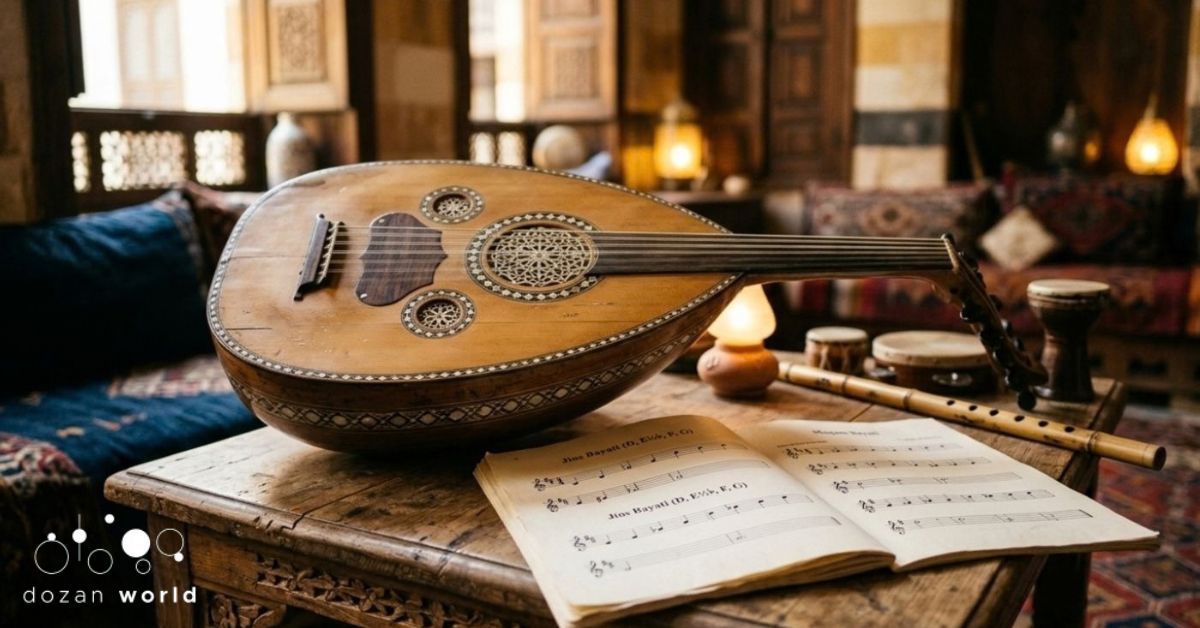
Maqam Bayati is one of the most widely used and recognizable maqamat in Arabic music. Built on a lower tetrachord with a characteristic quarter-tone-flat second degree, it has a warm, introspective sound that Western major and minor scales cannot reproduce. Bayati appears throughout vocal and instrumental repertoire across the Arab world, which is why it's often one of the first maqamat students and choir directors encounter when they start exploring Arabic music.
A maqam is not simply a scale. It's a melodic framework that includes a set of pitches, a hierarchy of important notes, characteristic phrases, and specific ornamentation. Maqam Bayati is one of the foundational maqamat in Arabic music, and it guides how a melody should move, not just which notes it can use.
Bayati is typically one of the first maqamat introduced to students, since its structure is approachable and its emotional character is easy to recognize by ear.
Bayati's popularity comes from its flexibility and emotional range. It suits slow, lyrical melodies as well as faster, more rhythmic ones.
It would be inaccurate to call Bayati the single most common maqam in every context, since usage varies by region, genre, and era. What can be said with confidence is that it's one of the most frequently used and recognizable maqamat in the tradition.
Maqam Bayati is built on a lower tetrachord known as jins Bayati. Using D as a common theoretical tonic, the notes are approximately D, E half-flat, F, and G, continuing upward into jins Rast or jins Nahawand depending on the melodic direction.
The second degree, E half-flat, is what gives Bayati its identity. It sits between a Western E-flat and E-natural, and it's the pitch most listeners recognize as the "Arabic" quality in the sound.
The tonic can be transposed to any pitch; D is however the original note. Exact intonation also shifts slightly by performer, instrument, and regional tradition, so not every performance lands on identical absolute pitches.
Maqam Bayati

Yes. Maqam Bayati includes one characteristic quarter-tone-flat note, the second degree of its lower tetrachord. That doesn't mean every note in Bayati is a quarter tone; most of the scale is close to what Western musicians would recognize, and it's this one distinctive note that carries the maqam's identity.
A quarter tone sits roughly halfway between two adjacent Western semitones. Scores usually mark it with a half-flat symbol, but the precise pitch a singer or instrumentalist lands on varies by tradition and personal style, which is why "quarter tone" is a useful approximation rather than a complete description of how Bayati is actually performed. Listening closely to recordings matters, since staff notation alone doesn't fully capture the pitch or the way performers slide into and out of that note.
Listeners often describe Bayati as warm, intimate, and emotionally direct, somewhere between longing and comfort, which is part of why it works well in both devotional music and secular love songs. That character comes directly from the lowered second degree, which shifts the emotional weight of the tetrachord and gives Bayati a sound immediately identifiable as Middle Eastern, even to listeners with no maqam training. Combined with ornamentation such as slides and grace notes around the second degree, Bayati has a vocal, singable quality that translates naturally to both voice and instruments.
Western musicians often reach for the word "scale" as a starting comparison, but maqam and scale aren't the same concept. A scale is a fixed set of pitches; a maqam includes that pitch set but also carries melodic behavior, ornamentation, and performance conventions that shape how a piece actually sounds.
|
Feature |
Maqam Bayati |
Western Major/Minor Scale |
|
Basic concept |
Melodic framework |
Pitch collection |
|
Intonation |
May include microtonal inflections |
Usually equal temperament |
|
Melodic movement |
Central to themaqam's identity |
Doesn't define behavior alone |
|
Ornamentation |
Often essential to performance |
Varies by style |
|
Important pitches |
Certain notes carry specific emphasis |
Depends on harmony and melody |
|
Improvisation |
Strong role, including taqsim |
Varies by genre |
|
Cultural context |
Arabic and Middle Eastern traditions |
Western art and popular traditions |
Two performers can read the same Bayati notation and produce noticeably different, equally valid interpretations, depending on ornamentation and regional style, a kind of variation far less common in Western scale-based music.
The maqam system is the modal framework behind Arabic music, similar in function to the Western major and minor key system, though structured differently. Each maqam (plural: maqamat) is built from smaller units called ajnas (singular: jins), short tetrachords with their own character.
Beginners don't need the whole system to understand Bayati. Knowing how ajnas combine simply explains why Bayati often connects smoothly to maqamat like Rast, Nahawand, or Hijaz within the same piece.
Bayati is well represented across Arabic vocal and instrumental repertoire, including classical songs, Levantine folk traditions, and devotional music, and it's a common choice for melodies that call for emotional depth and lyrical phrasing.
Many Arabic compositions also modulate between maqamat over the course of a piece. A song that opens in Bayati may move into Rast, Hijaz, or another related maqam as it develops, so identifying the opening maqam is a useful starting point, not proof the entire piece stays in Bayati.
Learning Bayati works best as a mix of listening and hands-on practice. Reading notation alone won't fully convey the intonation or ornamentation.
Listening and imitation matter because traditional maqam intonation is hard to capture fully in Western staff notation. A score gives you the framework; recordings give you the details.
Yes, though instruments vary in how easily they handle the quarter tones. Violin, viola, cello, flute, and clarinet can approach the microtonal second degree through adjusted finger placement, alternate fingerings, or embouchure technique. Fixed-pitch instruments such as standard pianos are more limited, since they can't bend individual notes, though some arrangements work around this with careful voicing. Guitarists typically use adjusted fingering or partial bends, and keyboards with microtonal tuning can reproduce Bayati more precisely.
Our instrumental sheet music collection includes pieces across several maqamat, with notation that marks microtonal intervals clearly so performers know exactly where the characteristic pitches occur.
Arabic sheet music generally uses Western staff notation with added accidentals for quarter tones. A half-flat symbol is the most common way to mark Bayati's lowered second degree, though conventions can differ slightly between publishers, so it's worth following the guidance provided with a specific arrangement rather than assuming every score uses identical symbols. Listening to a recording alongside the written score, when one's available, remains one of the most reliable ways to understand how a piece should sound.
Understanding Bayati helps musicians interpret Arabic melodies accurately rather than treat them as a Western piece with unusual accidentals. Once a performer recognizes which maqam a piece is built on, decisions about phrasing, ornamentation, and pitch shading become much clearer, which is one reason we build our Arabic sheet music with notation and performance notes for musicians encountering maqam-based music for the first time.
When choosing Arabic sheet music, look for:
We publish across choral, vocal, and instrumental categories, with works arranged for SATB, SAB, SSA, and other vocal formations, alongside solo and chamber instrumental pieces. Our mixed choir and SATB collection includes maqam-based works with notation built for musicians working outside the Arabic tradition for the first time. For a closer look at how quarter tones show up on the page, our guide to reading Arabic music scores walks through the notation in more detail.
Bayati's warm, lyrical character makes it a strong fit for choral and vocal repertoire. Its phrases sit comfortably in the voice, and its emotional range works for both sacred and secular programming.
Our vocal and human voices collection includes Bayati-based works alongside pieces in other common maqamat, a practical starting point for choirs building their first Middle Eastern program.
Maqam Bayati isn't just a group of notes. Its identity comes from melodic phrases, characteristic intervals, emphasized notes, intonation, ornamentation, and traditional performance practice working together. That's the difference between playing the right notes and actually sounding like Bayati.
What is Maqam Bayati?
One of the most widely used maqamat in Arabic music, built on a lower tetrachord with a quarter-tone-flat second degree that gives it a warm, expressive sound.
Is Bayati the most common maqam in Arabic music?
It's one of the most widely used and recognizable, but usage varies by region, genre, and era, so calling it the single most common maqam in every context would be inaccurate.
What notes are in the Bayati scale?
Using D as its tonic, the lower tetrachord is roughly D, E half-flat, F, and G, continuing into a related jins depending on the piece. The tonic can be transposed to any pitch.
Does Maqam Bayati have a quarter tone?
Yes, its second degree is a quarter-tone-flat note that gives Bayati its distinctive character. The rest of the scale is closer to pitches Western musicians will recognize.
What does Maqam Bayati sound like?
Warm, intimate, and emotionally direct, often described as melancholic or introspective, a character that comes from the lowered second degree and its typical ornamentation.
How is Bayati different from a Western scale?
A Western scale is a fixed pitch collection. Bayati is a melodic framework that also includes ornamentation, emphasized notes, and performance conventions, so the same notation can sound different from one performer to the next.
What is the difference between maqam and scale?
A scale is a set of pitches. A maqam includes a pitch set but also defines melodic direction, important notes, typical phrases, and ornamentation.
Can Western instruments play Maqam Bayati?
Yes. Violin and cello can adjust finger placement, and some woodwinds use alternate fingerings or embouchure changes. Fixed-pitch instruments like standard pianos are more limited but can still approximate the maqam in arrangement.
How can beginners practice Bayati?
Combine listening with slow, focused practice, starting with the tetrachord and its characteristic second degree, then work through short phrases before full melodies.
Where can I find Arabic sheet music using maqam?
We publish Arabic and Middle Eastern sheet music across choral, vocal, and instrumental categories, with notation that marks quarter tones clearly for musicians new to maqam-based repertoire.
Maqam Bayati is one of the most widely used and recognizable maqamat in Arabic music, built around a distinctive lowered second degree that gives it a warm, expressive character no Western scale fully replicates. Understanding its structure, its quarter-tone intonation, and its place in the wider maqam system gives musicians a real foundation for approaching Arabic repertoire with confidence, whether they're reading a score for the first time or refining years of performance experience.
Listening matters just as much as notation when learning Bayati, since so much of its character lives in ornamentation and intonation that staff notation can only approximate. If you're ready to bring this repertoire into your own performances, our Arabic and Middle Eastern sheet music collections include Bayati-based works for choirs, vocalists, and instrumentalists at a range of skill levels.