
Votre panier est vide
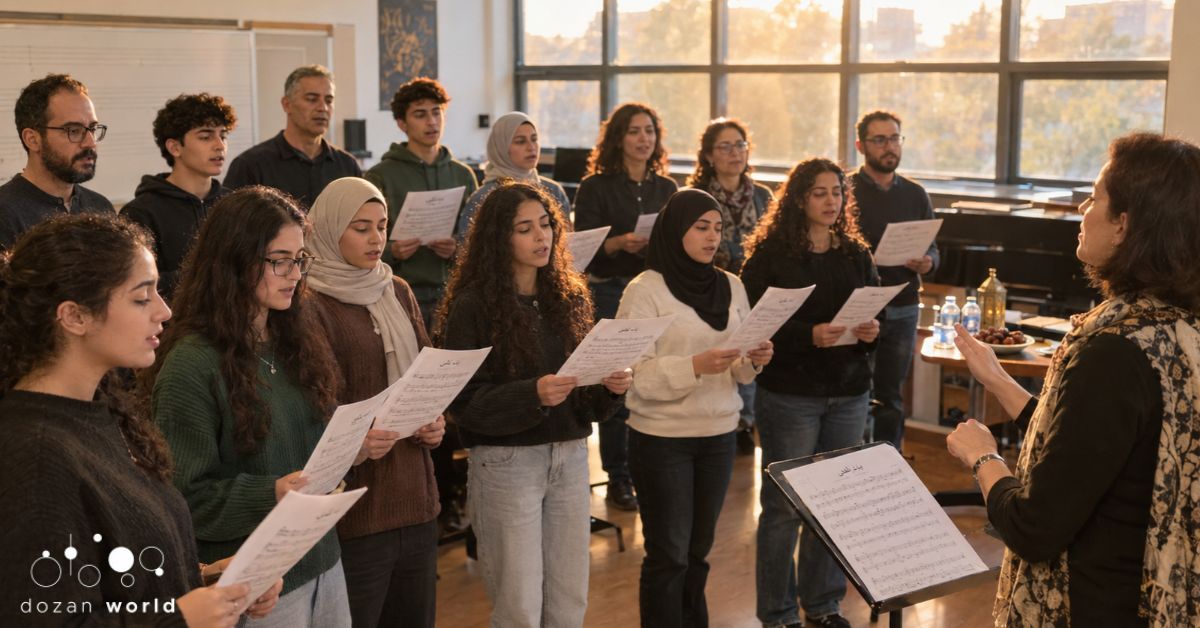
Dozan World was founded by Dr. Shireen Abu Khader, a Palestinian Jordanian composer and educator with a Master’s degree in Choral Music from the University of Southern California and a PhD from the University of Toronto.
Quick answer: Ramadan is the Islamic holy month of fasting, prayer, and reflection. Eid al-Fitr is the celebration that marks its end. They are different occasions and call for different musical choices. Muslims hold different views on music, so no single practice represents everyone. To build a respectful program, choose music that truly connects to the occasion, learn the lyrics and Arabic pronunciation, plan around fasting and prayer, and ask Muslim students, families, and community members for input.
Ramadan and Eid choral music is choral repertoire connected to the holy month of Ramadan or to Eid al-Fitr, often drawn from Arabic and Middle Eastern traditions. It is not one genre. Because both occasions are religious and cultural, the lyrics, context, and community expectations matter as much as the notes.
Ramadan is the ninth month of the Islamic lunar calendar. Eid al-Fitr marks the end of that month. They are two separate occasions.
During the month of Ramadan, Muslims who are able fast from dawn to sunset. The month is also a time of prayer, reflection, charity, and community. The Islamic calendar follows the moon, so Ramadan begins about 10 to 12 days earlier each year and can fall in any season.
Eid al-Fitr, often translated as the festival of breaking the fast, begins with a special communal prayer. Families then gather for meals, visits, gifts, and charity.
Ramadan is a month of religious observance, not a festival. Eid is the celebration that follows. That is why reflective themes often suit Ramadan while joyful themes often suit Eid, though practices differ between communities.
There is no single answer. Muslims and Muslim scholars hold different views on music, and personal observance varies from person to person and family to family. We do not offer a religious ruling here, and a choir director should not assume one policy fits every Muslim student.
Research on this subject describes the disagreement plainly: many Islamic scholars consider music forbidden, and many others consider it permitted.
For choir directors, the practical steps matter most:
Not every Muslim does. Some choose to reduce or avoid music during Ramadan to focus on prayer, reflection, and self-discipline. Others keep listening to or performing music.
The reasons vary. Some people follow a particular scholarly interpretation. Others follow a family or community tradition, or make a personal choice. Practice also differs between regions. In many Arabic-speaking communities, seasonal Ramadan songs are a long-established tradition. Avoiding music is not a universal Ramadan rule.
The key practices are fasting, prayer, reflection, charity, and community.
These fasting and prayer routines shape the day. Fasting singers may have less energy later in the day, and evenings may be full of prayer and family meals. That is why scheduling matters as much as repertoire.
Schools can acknowledge Ramadan through education, student voice, and flexibility rather than a themed performance. The goal is understanding, not decoration.
For younger classes, activities such as our Yalla, Let’s Sing and Play can introduce children to Middle Eastern music in the classroom.
There is no universal answer. Judge each piece by its lyrics, religious and cultural context, occasion, audience, and community expectations. Not every Arabic song is a Ramadan song, and not every Arabic song is religious.
It helps to sort options by type: devotional and religious repertoire (which needs extra care with context), folk songs, secular Arabic songs, contemporary Arabic vocal music, and celebratory community songs.
Themes such as reflection, community, compassion, charity, hope, and peace often fit. Some songs are tied to the month itself. Al Jazeera’s film on Ramadan songs covers Ramadan Gana, Wahawi Ya Wahawi, and Allou El Bayarek, a song written for a children’s choir at a Beirut orphanage. These are examples of repertoire with a real Ramadan connection, which is the test to apply to every piece.
Themes such as joy, family, gratitude, celebration, and new beginnings often fit. Eid traditions vary by community, so ask what is sung locally instead of assuming.
Start with purpose, research every song, and involve the community. Follow these seven steps:
Authenticity comes from context, not language alone. A piece is not authentic just because it contains Arabic words.
Ask where the song comes from, who composed and wrote it, which region and period it belongs to, and how it was originally performed. Check that the translation is accurate and that the arrangement respects the original rhythm and phrasing.
Learn the musical language too. Many Arabic songs are built on maqam, and some use quarter tones, but not all do. Our guides to maqam, including Maqam Hijaz and Maqam Bayati and to Arabic music notation help directors prepare.
Pronunciation affects both musical quality and cultural accuracy. Use the original Arabic text alongside a reliable transliteration, an English translation, and a recording by a native speaker. Transliteration alone is not enough.
Watch for long and short vowels, emphatic consonants, and dialect. The letter jim, for example, sounds different in Cairo and in Beirut. Follow the dialect the song was written in, and ask a native speaker to confirm. Our pronunciation guides and digital resources are built for singers learning Arabic.
Yes, when they do the preparation. Western choirs can perform Arabic and Middle Eastern repertoire respectfully by studying the original music, understanding the lyrics, using careful pronunciation, and consulting knowledgeable people. A choir does not need to copy every traditional technique, but it should never imitate without context. Our post on Lamma Bada Yatathanna is a good first step for Western choirs.
Treat each song as belonging to a specific culture, region, and context. Avoid:
Instead, name the culture and region, learn the lyrics, listen to the original performance, and credit composers and traditions properly.
Plan around fasting and prayer, and stay flexible.
Because Ramadan shifts every year, check its dates early when you set the season calendar.
Look for accurate notation, Arabic lyrics, transliteration, an English translation, pronunciation guidance, composer information, arrangement details, vocal ranges, and audio references where available.
Our Arabic and Middle Eastern sheet music collection is organized so choirs can find fitting repertoire. Vocal sheet music is grouped by choir type, difficulty, and ensemble format. Sacred vocal music, including Arabic hymns, sits beside secular vocal music, which celebrates folk traditions and contemporary adaptations. Directors of mixed choirs can also look at our guide to Middle Eastern SATB scores and our SAB secular arrangements. Soloists can browse 24 Songs from the Arab World (medium voice).
Whichever collection you use, check each piece against the checklist below.
Before choosing a piece, ask:
Respect Comes Before Repertoire
A strong Ramadan or Eid choral program is not created by selecting Arabic songs. It takes cultural understanding, religious sensitivity, accurate lyrics, good pronunciation, respectful scheduling, and community consultation. The goal is to present Arabic and Middle Eastern music with understanding, not as a decorative theme.
Is it allowed to play music during Ramadan?
Muslims and scholars differ, so there is no single answer. Some Muslims avoid music during the month, while others continue to listen or perform. Personal, family, and community practice varies. Directors should ask participants, keep participation voluntary, and seek local guidance when needed instead of applying one rule to everyone.
Why do some people stop listening to music in Ramadan?
Some limit music to focus on prayer, reflection, and self-discipline, often following a particular scholarly view or family tradition. Many others do not stop. It is a personal choice, not a universal rule.
What is the difference between Ramadan and Eid?
Ramadan is the ninth Islamic month, observed through fasting, prayer, and charity. Eid al-Fitr is the celebration that follows it. One is a month of observance and the other is a festival of prayer, family, and joy, so programs for each should differ.
Can a choir perform Arabic music during Ramadan?
Yes, with care. Because views on music differ, offer voluntary participation, avoid assumptions about individual students, and think about the timing of rehearsals and performances. Choose pieces whose lyrics and context suit the setting.
What kind of music is appropriate for an Eid program?
No single repertoire fits every community. Folk songs, community songs, and celebratory pieces often suit Eid, and some programs include devotional works. Check each piece’s lyrics and context, and ask local Muslim families what is sung in their tradition.
How can a choir perform Arabic music respectfully?
Study the original song, understand the lyrics, learn pronunciation from native speakers, and respect the style and arrangement. Credit composers, avoid stereotypes, and give the audience context. Involving Arabic speakers makes a real difference.
How do you choose authentic Ramadan or Eid songs?
Start with songs that truly belong to the occasion, not just songs in Arabic. Research the composer, lyricist, region, and original performance, and check translations. When unsure, ask an Arabic speaker or a community member.
How should schools plan choir rehearsals during Ramadan?
Ask students what works, schedule shorter rehearsals, avoid iftar and prayer times, allow flexible attendance, and add listening practice. Keep participation voluntary and avoid singling out fasting students.
Ramadan is a month of fasting, prayer, and reflection, and Eid al-Fitr is the celebration that follows. They are not the same occasion, and Muslims hold different views on music. A respectful choral program starts with that awareness, then adds thoughtful repertoire, accurate lyrics, careful Arabic pronunciation, and considerate scheduling.
True authenticity comes from context and community input, not from adding Arabic words or instruments. We invite choir directors, music educators, students, and musicians to browse Dozan World’s Arabic and Middle Eastern sheet music collections and find repertoire that suits their musical needs.
Browse Dozan World’s Arabic and Middle Eastern Sheet Music Collections →