Your Cart is Empty
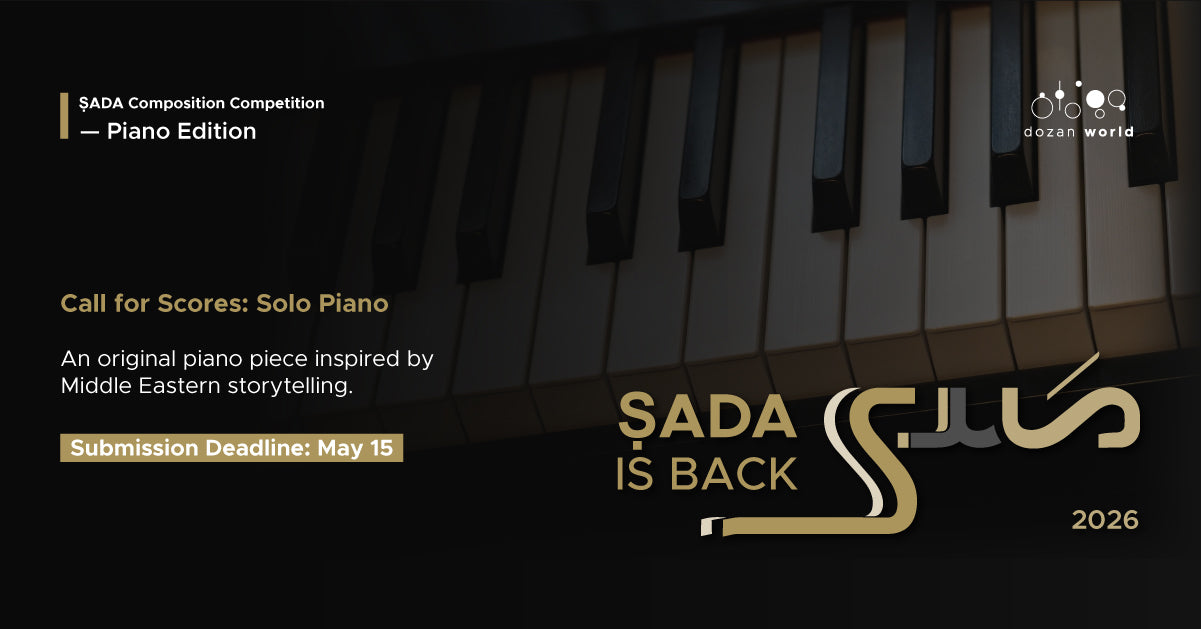
ṢADA returns this year not simply as a continuation, but as a reflection of something we feel deeply at Dozan World: that composers need space.
In the current moment, that need feels even more urgent. Many composers today are navigating instability, displacement, financial pressure, and emotional weight that make sustained creative work difficult. Time to think, to experiment, to write without immediate output; these are no longer given. And yet, composition asks for exactly that: presence, depth, and the ability to listen inward.
This is where ṢADA begins.
At Dozan, we see composers as the foundation of the musical ecosystem. They are the ones who carry memory into form, who translate feeling into structure, who shape how music moves forward across generations. But too often, they are left without the conditions needed to do that work fully.
ṢADA was created from within this commitment. Not simply to offer an opportunity, but to open a space. A space where composers can return to their voice, engage with their musical language more deeply, and create work that is both rooted and evolving.
This year, ṢADA takes the form of a piano edition. The choice of piano is intentional. It is one of the most widely accessible instruments in the world, present in homes, classrooms, and institutions across continents. It is often the first musical language many learn. And yet, it is rarely asked to fully hold the depth of Middle Eastern musical expression.
This is not about adapting tradition to fit the instrument. It is about allowing composers to bring their full musical identity to the piano, and in doing so, expanding what the instrument can carry.
At its core, this is not just about writing music. It is about storytelling.
We are interested in composers who are working from a place of honesty. Who are thinking about maqam not as surface, but as language. Who understand rhythm not only as meter, but as feel, as breath, as the shaping of time. Who are asking themselves what it means to write something that carries memory, tension, contradiction, and transformation.
Because this work is human, we ask that it be heard as such. We are interested in music that lives in touch, in gesture, in presence.
While there is a prize, what matters to us is what this space makes possible. At Dozan, we are not only looking to present work; we are looking to stand behind it. To support composers in ways that extend beyond a single moment, and to contribute to a growing body of repertoire that reflects the richness and complexity of our musical worlds.
If you have ever felt that your voice exists between traditions, if you have struggled to find space to write, or if you are searching for a way to express something that feels both deeply rooted and entirely your own, this is an invitation.
For full submission details and guidelines, please visit the competition page.
ṢADA means “echo.” But an echo is never just repetition; it is something that continues, reshaped by everything it passes through.
The question is not only what your echo will sound like, but what it carries forward.
For full submission details and guidelines, visit the competition page here