Your Cart is Empty

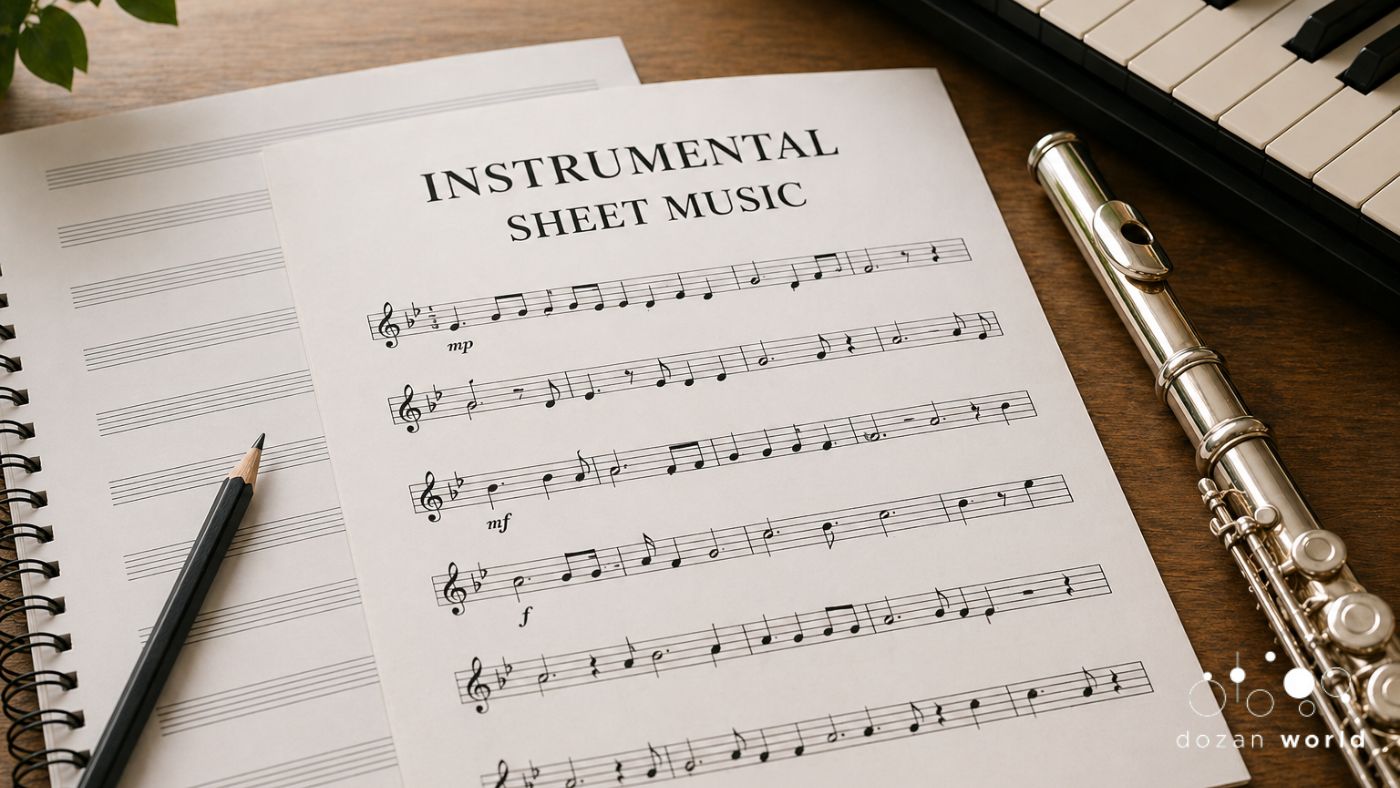
Middle Eastern instrumental music brings a different set of tools to the page than most Western repertoire: modal scales instead of chord progressions, quarter tones instead of even semitones, and rhythmic cycles built for instruments like the oud and qanun. This guide walks through what to expect from Middle Eastern instrumental sheet music, which instruments it covers, how to judge difficulty, and where to find scores that are accurate and properly licensed.
Middle Eastern music refers to the musical traditions of the region spanning countries such as Lebanon, Syria, Egypt, Jordan, Palestine, and their neighbors. Unlike Western classical or pop music, it is not built primarily around harmony and chord changes. Instead, it centers on maqam, a system of melodic modes, and iqa'at, the rhythmic cycles that give a piece its pulse. Quarter tones, the in-between pitches that sit between standard Western notes, are one of its defining features, giving the music an expressive, fluid quality that a fixed twelve-tone scale cannot fully capture.
Traditional instruments carry this sound. The oud, a fretless pear-shaped lute, is often the lead melodic voice. The qanun, a plucked trapezoidal zither, is known for its role in setting the maqam for an ensemble at the start of a performance. The ney, an end-blown reed flute, and the violin, adapted with quarter-tone tuning, round out the classical takht ensemble alongside percussion instruments like the darbuka and riq.
Instrumental sheet music from this tradition is not limited to Middle Eastern instruments alone. Much of it is arranged for instruments familiar to Western-trained musicians, adapted to carry maqam-based melodies.
Piano. The piano's visual layout makes it a practical entry point into maqam, since musicians can see interval relationships clearly on the keyboard, even though the instrument itself cannot produce true quarter tones without retuning.
Strings. Violin, viola, cello, and string quartet arrangements are common, since bowed strings can slide into quarter tones naturally, much like the traditional violin does in a takht ensemble.
Woodwinds and brass. Flute, clarinet, and small ensemble arrangements bring Middle Eastern melodies to instrumentation more typical of a Western wind ensemble or chamber group.
Traditional instruments. Scores written specifically for oud, qanun, or ney remain central to the tradition and are often the most accurate representation of a maqam's true character.
Dozan World's instrumental collection spans this full range, from chamber arrangements to traditional solo pieces, so musicians can find scores that match the instrument already in their hands.
Searches for a free PDF download are common, and it is worth explaining why that approach usually falls short. Much of the Middle Eastern repertoire that circulates as free scans or handwritten PDFs online was transcribed informally, often without accurate quarter-tone notation or reliable sourcing. A misplaced half-flat changes a maqam's entire character, and free, uncredited scores rarely go through the kind of proofreading a published score does.
A properly licensed digital download solves this in two ways. It supports the composers and arrangers who prepared the score, and it gives a musician confidence that the notation on the page matches what the piece is meant to sound like. Dozan World publishes instrumental scores as digital downloads with accurate maqam notation, so a purchased score is both authentic and ready to perform. We also offer a selection of free downloads, giving musicians a chance to sample our notation quality before purchasing a full score.
Middle Eastern instrumental music spans a wide range of difficulty, and matching a score to a musician's current level matters as much here as it does in any other tradition.
Beginner-friendly pieces tend to stay within simpler maqam families, such as Ajam or Nahawand, which sound close to familiar Western major and harmonic minor scales. These pieces are a practical starting point for musicians new to quarter tones.
Intermediate pieces introduce more quarter-tone movement and begin to draw on maqamat like Bayati or Kurd, asking for more precise intonation and a developing ear for the style.
Advanced repertoire includes maqam modulation within a single piece, more demanding ornamentation, and rhythmic cycles that shift partway through, all of which ask for real familiarity with the tradition.
Checking a score's notes or performance guidance before buying is the simplest way to judge whether a piece fits a musician's current level.
Arabic instrumental notation uses the same staff, clefs, and note names as Western sheet music, with quarter tones marked using half-flat and half-sharp symbols layered on top. This makes a score readable to any Western-trained musician, though performing it accurately still depends on understanding the maqam behind the notes and listening closely to how it should sound. For a deeper look at this system, our guide on Arabic music notation, quarter tones, and maqam walks through the basics in more detail.
A few pieces in Dozan World's catalog give musicians a practical starting point. Egyptian Tango blends a familiar Western dance form with Middle Eastern melodic color, making it approachable for musicians new to the style. Longa Farahfaza is a classical instrumental form built on a lively rhythmic cycle, giving performers a taste of traditional Arabic instrumental structure. For chamber ensembles, our Woodwind Trio arrangement adapts Middle Eastern melody for flute, clarinet, and bassoon, and our related guide to woodwind trio arrangements covers the piece in more depth.
In Arabic, this musical tradition is called al-musiqa al-arabiyya, or simply musiqa, the general Arabic word for music. Within the tradition, the term tarab refers specifically to the emotional, almost transporting quality that classical Arabic music can create in a listener, while maqam refers to the melodic mode system that shapes a piece's scale and mood.
Umm Kulthum, the Egyptian singer active from the 1920s until her death in 1975, is widely regarded as the most influential voice in Arabic music history, often called the Star of the East. Fairuz, the Lebanese singer known as the Jewel of Lebanon, holds a similarly legendary status, especially across the Levant. Among more recent artists, Amr Diab is frequently recognized as the best-selling Middle Eastern artist, known for blending Arabic melody with contemporary pop production.
There is no single agreed-upon answer, since popularity varies widely by country, era, and generation, but Umm Kulthum's "Enta Omri" is consistently named among the most beloved and enduring songs in Arabic music history, along with Fairuz classics like "Li Beirut." These vocal works sit alongside the instrumental tradition covered in this guide, and many instrumental arrangements draw directly on melodies from this same songbook.
What is instrumental sheet music in Middle Eastern music?
It is written notation for Middle Eastern melodies and rhythms, adapted for instruments ranging from oud and qanun to piano, strings, and woodwinds, using staff notation with added quarter-tone symbols.
Is Middle Eastern instrumental sheet music hard to read?
If you can already read Western staff notation, the main new skill is recognizing quarter-tone symbols and understanding the maqam behind a piece. It takes practice, but it is learnable with the right score.
Can I find Middle Eastern instrumental sheet music free?
Free scores exist online, but many are informally transcribed without accurate quarter-tone notation. A licensed digital download offers more reliable notation and supports the arrangers behind the work.
What instruments are used in Middle Eastern instrumental music?
Traditional instruments include the oud, qanun, ney, and darbuka, alongside Western instruments like piano, violin, and woodwinds that are commonly used in arrangements of Middle Eastern repertoire.
What is a good beginner piece for Middle Eastern instrumental music?
Pieces built on maqam families like Ajam or Nahawand tend to sound closest to familiar Western scales, making them a practical starting point for beginners.
What is Middle Eastern music?
Middle Eastern music is the musical tradition of the region, built around maqam melodic modes and rhythmic cycles rather than Western harmony, often featuring quarter tones and instruments like the oud and qanun.
What is Arab music called?
In Arabic, it is called al-musiqa al-arabiyya, or simply musiqa. Related terms include tarab, referring to the music's emotional effect, and maqam, its melodic mode system.
Who is the most famous Middle Eastern singer?
Umm Kulthum is widely regarded as the most legendary voice in Arabic music history, with Fairuz and, more recently, Amr Diab also recognized among the region's most celebrated artists.
Does Middle Eastern instrumental sheet music reflect authentic tradition?
Well-prepared scores aim to preserve accurate maqam notation, ornamentation, and stylistic detail, though the oral tradition behind the music means a score works best alongside careful listening.
Where can I buy Middle Eastern instrumental sheet music?
Dozan World publishes a catalog of Middle Eastern instrumental scores as digital downloads, spanning piano, strings, woodwinds, and traditional instrumental arrangements.
Middle Eastern instrumental music offers a genuinely different musical vocabulary, one built on melody and rhythm rather than harmony, and reading it well starts with a score you can actually trust. Whether you are picking up your first piece in a familiar maqam or working toward more advanced repertoire, accurate notation makes the difference between a piece that sounds right and one that only looks right on the page.
Browse Dozan World's instrumental sheet music collection to find a piece that matches your instrument and level, and visit our full catalog to see how this tradition extends across vocal and choral music as well.