Your Cart is Empty

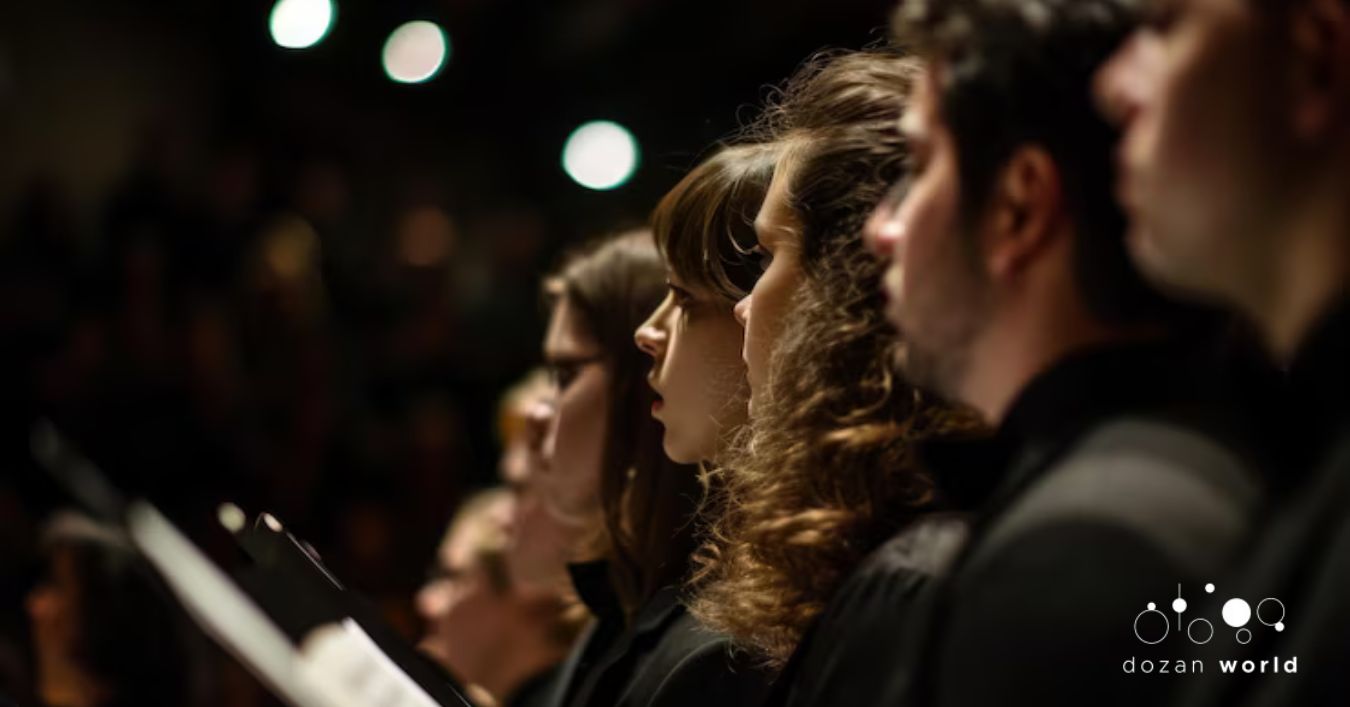
When most choir directors think of Middle Eastern music, sacred repertoire comes to mind first. Byzantine liturgy, Maronite hymns, Sufi devotional song. That association is understandable because the religious music of the region is extraordinary, and much of it has been documented and performed globally for decades. But there is an entire world of secular choral music from the Middle East that most choirs have never encountered, and it deserves a place in your rehearsal folder.
At Dozan World, we have spent years curating and notating secular choral works rooted in the Arab world and the Levant. Love songs, poetry set to music, regional folk traditions, and muwashshah compositions from medieval Andalusia that carried their way east. This music is emotionally rich, rhythmically alive, and entirely fresh to most Western ears. If your choir is ready to expand beyond the familiar, this is the perfect place to start.
This is not background music or novelty repertoire. Secular choral works from the Middle East carry the same weight and intention as any Western art song or folk arrangement. The difference lies in the musical language.
Most of these pieces are built on the maqam system, which is the modal framework at the heart of Arabic music. A maqam is more than a scale. It carries a melodic personality, specific ornamental phrases, and an emotional character that a trained musician can recognize immediately. Maqam Nahawand, for example, sits close to the Western harmonic minor scale, which makes it one of the most accessible entry points for choirs without prior experience in Middle Eastern music. Maqam Hijaz, on the other hand, has a distinct raised second that Western ears find both unfamiliar and deeply compelling.
Many secular pieces also use the muwashshah form, a structured poetic musical tradition that developed in Moorish Spain and became central to Arab vocal music across the Levant and Egypt. Our piece Lamma Bada Yatathanna, one of the most beloved muwashahat ever composed, is available in multiple SATB and SSAA arrangements and serves as an ideal starting piece for any ensemble.
Choirs that learn Middle Eastern secular music report something consistent: the learning process sharpens their ears in ways that other repertoire does not. Quarter tone inflections, unfamiliar rhythmic cycles, and ornamental phrasing all require a level of listening and precision that strengthens ensemble technique across the board.
Beyond the musical training, look at the audience perspective. A choir that can perform Ya Hinna, a piece built on the vibrant Hijaz maqam with driving rhythmic energy, or Shaghili Bilhusni Badron, an Egyptian muwashshah in Nahawand with an entirely new rhythmic cycle called Dawr Hindi, offers its audience something genuinely memorable. These are not pieces people have heard before, and that novelty holds real value on a concert program.
There is also the cultural dimension. The Middle East is the cradle of three major world religions and home to dozens of linguistic and ethnic communities, each with distinct musical traditions. When a choir learns this music, they are engaging with living cultural memory. That matters deeply to both the singers and the communities watching them perform.
Dozan World was founded by Shireen Abu Khader, a Palestinian Jordanian composer, educator, and choral director based in Toronto. Shireen has performed with ensembles worldwide and brings both scholarly rigor and practical performance experience to every score in our catalogue. That background shapes how our sheet music is prepared.
Our secular choral scores are notated specifically for Western musicians. You will find standard staff notation, clear dynamic markings, and pronunciation guides whenever the text is in Arabic. We have worked to preserve the cultural authenticity of each piece while making it genuinely learnable for ensembles whose musicians were trained in the Western classical tradition. You do not need to speak Arabic or have a background in maqam theory to pick up these scores. The music teaches you as you go.
Our secular vocal collection includes pieces arranged for SATB, SSAA, SAB, and mixed configurations. Difficulty levels range from pieces accessible to amateur ensembles to more complex arrangements for advanced choirs. We continue to add to the collection regularly, working directly with composers from the region.
If your choir is new to Middle Eastern music, we recommend starting with Lamma Bada Yatathanna. Its Nahawand maqam is familiar enough to Western ears that the learning curve is manageable, and the melody is genuinely beautiful, the kind that stays with singers long after rehearsal ends. From there, works like Ya Hinna and Shaghili Bilhusni Badron offer more rhythmic challenge and a richer introduction to what Arabic secular choral writing can do.
Take a look through our secular choral works collection to see the full range of what is available. You can also visit our complete collections page to see how our secular repertoire sits alongside our sacred and instrumental offerings. If you have questions about choosing pieces for your ensemble, get in touch. We are happy to help.
This music has waited long enough for a wider audience. Your choir is a wonderful place to start.
Do I need to be familiar with Arabic music or the maqam system before using these scores?
No. Our scores are prepared for Western trained musicians, with staff notation, dynamic markings, and pronunciation guides included. Familiarity with maqam will develop naturally as you work through the music. Many of the pieces in our secular collection use maqamat such as Nahawand that share close similarities with Western scales, so the learning curve is more manageable than you might expect.
Are these secular choral works suitable for amateur or community choirs, or are they written for professional ensembles?
We have pieces across both ends of the spectrum. Some works in our secular collection are arranged to be accessible to amateur and community choirs, while others are better suited to advanced ensembles. Each piece in the catalogue includes information on vocal configuration and difficulty level so you can choose what fits your group best.
What vocal configurations are available in the secular choral collection?
Our secular choral works are available in several arrangements including SATB, SSAA, SAB, and mixed configurations with instruments. We continue to expand the collection, so new arrangements are added regularly.
Is this music appropriate for concert performance, or is it primarily intended for educational use?
Both. Many of our secular pieces are fully suitable for concert programming and have been performed on stage by choral ensembles internationally. At the same time, the scores work well in educational settings, including music schools, university choral programs, and community music programs where cultural diversity in repertoire is a goal.
Can a choir outside the Middle East perform this music respectfully without losing the cultural context?
Yes, and we believe this kind of cross cultural performance is exactly what this music needs. Our scores include contextual notes on the maqam, the poetic tradition, and the cultural background of each piece, giving your ensemble the information they need to perform with understanding rather than just treating it as a novelty. Shireen Abu Khader, our founder, has built the entire catalogue around the principle that this music deserves global performance done with care.